

Inductive Proximity Switches Market Size to Reach USD 4.24 Billion by 2033, Growing at 7.1% CAGR as Industrial Automation and Non-Contact Sensing Demand Accelerate – Verified Market Research
Global Inductive Proximity Switches Market demand is expanding as manufacturers replace contact-based limit switches with durable, non-contact sensing to protect uptime across automotive, packaging, food and beverage, and pharmaceutical production lines. The Inductive Proximity Switches Industry is being reshaped by tighter integration with industrial control architectures, rising qualification and compliance requirements, and product evolution toward longer sensing reach and configurable form factors. Asia Pacific currently leads global consumption on the strength of rapid industrialization and automation adoption, while North America and Europe continue to anchor demand through compliance-driven, quality-first procurement.
LEWES, Delaware, Sept. 02, 2026 (GLOBE NEWSWIRE) -- The Global Inductive Proximity Switches Market Size was valued at USD 2.93 Billion in 2025 and is projected to reach USD 4.24 Billion by 2033, registering a Compound Annual Growth Rate (CAGR) of 7.1% over the 2025–2033 forecast period, according to a new industry analysis published by Verified Market Research®. The Inductive Proximity Switches Market Size trajectory reflects steady demand across industrial automation and safety-oriented sensing use cases, as equipment makers modernize sensing architectures and end-user industries standardize reliability and diagnostics requirements across production environments.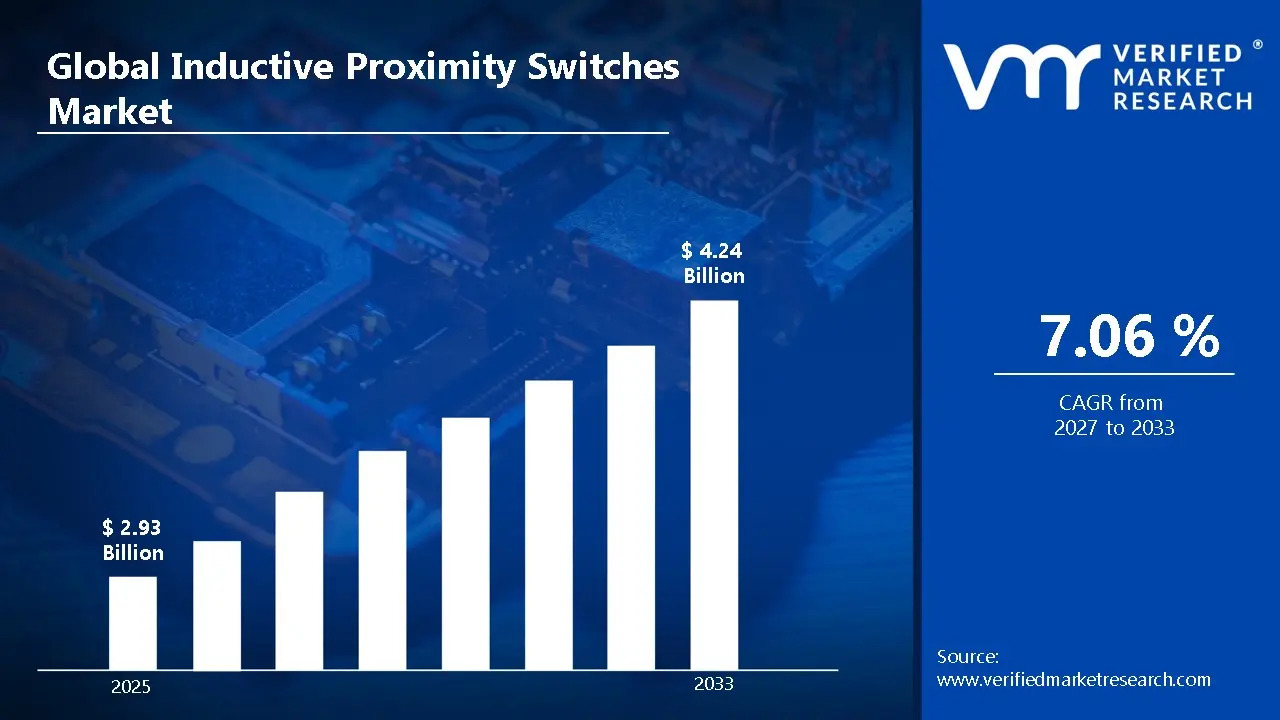 Download a free sample to access exclusive Insights, Data Charts, And Forecasts From Inductive Proximity Switches Market Sample Report
The Inductive Proximity Switches Market Growth outlook is further supported by the ongoing shift toward industrial connectivity, in which proximity switches increasingly function as components within larger control and monitoring ecosystems rather than as stand-alone detection hardware. Lifecycle considerations such as installation simplicity, durability in harsh environments, and reduced maintenance downtime are also shaping purchasing decisions for both original equipment manufacturer (OEM) production lines and retrofit programs, reinforcing demand consistency across multiple applications through the forecast horizon.
Market Overview: Scope, Definition, and Strategic Relevance
The Inductive Proximity Switches Market covers the commercial market for inductive proximity sensing devices that detect the presence, absence, or position of metallic targets without physical contact. These systems translate electromagnetic sensing into discrete switching outputs or compatible industrial signaling, enabling machine automation in settings where reliable detection under harsh conditions is required. Market participation spans the supply and sale of inductive proximity switch hardware across the full device lifecycle, together with the integration-ready configurations that define how each sensor is mounted, powered, and wired into control systems.
The defining technical boundary of the Inductive Proximity Switches Industry is sensing technology and functional behavior these devices operate on electromagnetic induction principles and are purpose-built to sense conductive, or metal, targets. Coverage in the report extends to the structural variants reflected in how devices are engineered and specified, including product form factor, sensing range capability, and intended application setting, since these specification-driven differences directly influence compatibility with end-user machinery, safety and control architectures, and installation constraints.
Several adjacent categories are explicitly excluded from the scope of the Inductive Proximity Switches Market because they represent different sensing modalities and procurement logic:
- Capacitive proximity switches - excluded because target detection relies on dielectric properties rather than induction, altering performance around non-metallic materials.
- Photoelectric sensors - excluded because they depend on optical interruption or reflection rather than electromagnetic induction, resulting in different environmental sensitivities and mounting requirements.
- Mechanical limit switches - excluded because detection occurs through physical contact and actuator mechanics, placing them in a distinct value chain and selection rationale.
- Downstream control units, programmable logic controllers, general-purpose automation software, and turnkey machine systems - excluded unless the primary economic and functional unit sold is the inductive proximity switch device itself.
This clearly bounded scope ensures that the Inductive Proximity Switches Market Size and Inductive Proximity Switches Market Forecast reflect a technology-focused, specification-aligned, and procurement-relevant category that is consistently interpretable across product, performance range, application setting, and end-user industry.
Download a free sample to access exclusive Insights, Data Charts, And Forecasts From Inductive Proximity Switches Market Sample Report
Key Growth Drivers Fueling the Inductive Proximity Switches Market
The Inductive Proximity Switches Market Growth is underpinned by three primary drivers identified in the Verified Market Research® analysis, each reflecting a distinct cause-and-effect mechanism connecting industrial operating priorities to sensor procurement.
1. Shift Toward Rugged, Non-Contact Sensing for Automation
Inductive proximity switches reduce mechanical wear compared with contact-based limit detection, making them well suited to high-cycle automation in constrained industrial layouts. As factories modernize production and raise uptime requirements, maintenance planning increasingly favors sensors that avoid contact degradation. This directly expands demand for Inductive Proximity Switches Market units where status detection, position verification, and safety interlocks require durable performance over extended duty cycles.
2. Intensifying Industrial Compliance and Safety Expectations
Where plant operators must demonstrate reliable detection in safety-relevant machine functions, switch designs are selected through qualification- and documentation-heavy procurement processes. Inductive proximity technology offers predictable behavior under typical industrial conditions, reducing validation uncertainty during commissioning. As procurement standards tighten across manufacturing environments, suppliers must deliver consistent variants and documentation, increasing the share of inductive proximity solutions specified across machine platforms.
3. Product Evolution Toward Longer Sensing Reach and Configurable Form Factors
Rising equipment density requires engineers to place sensors flexibly without redesigning mounting structures. Advances in electronics and magnetic sensing behavior support improved operating reach and stable detection at practical installation distances, while wider availability of cylindrical, rectangular, and ring form factors reduces mechanical integration friction. These changes translate into higher adoption rates by extending the range of machines that can standardize on inductive proximity switches.
Ecosystem-Level Drivers
Across the broader ecosystem, distributor networks, component consolidation, and supply chain responsiveness increasingly determine how quickly qualification projects can be executed. As manufacturers standardize switch families to simplify bill-of-materials management, suppliers are incentivized to expand cross-compatibility and stocking strategies for common variants. Capacity expansion and consolidation among electronics and sensing component producers also help reduce lead-time risk, which matters for automation retrofits scheduled around production downtime windows.
Driver intensity varies meaningfully by application and end-user context. Automotive line modernization prioritizes robust non-contact detection to sustain high throughput with minimal downtime, driving frequent retrofits for part-presence, position, and interlock confirmation. Food and beverage buyers emphasize consistent detection through repeated washdown and cleaning cycles. Pharmaceutical manufacturers favor proven, documented sensor families that reduce re-validation effort. Packaging operations value flexible installation and stable position detection across variable mechanical clearances. In parallel, manufacturing end-users anchor volume through steady replacement demand, electronics buyers prioritize compact, precision-friendly integration, and aerospace purchasers apply the strictest reliability and qualification criteria.
Emerging Opportunities Across the Inductive Proximity Switches Industry
Verified Market Research® identifies several opportunity clusters within the Inductive Proximity Switches Market that are directly supported by current demand structures and unmet buyer requirements.
Automotive Enclosure Hardening and Qualification-Led Expansion
As automotive platforms broaden functional electronics coverage per vehicle, the number and variety of proximity sensing points is increasing. Buyers are prioritizing stable actuation behavior under vibration, temperature swings, and contamination, creating opportunity for suppliers that align sensing design and enclosure execution with vehicle assembly realities where field failures are costly, supported by qualification-led sourcing and model-specific stocking strategies.
Food and Beverage Hygiene Alignment
Food and beverage facilities are modernizing filling, packaging, and conveyor control to reduce downtime and sanitation-related maintenance. Existing installations often underperform when exposed to cleaning cycles and chemical detergents, creating opportunity for improved sealing, housing materials, and sensing stability that can convert replacement cycles into incremental share gains across regional food processing networks.
Pharmaceutical and Packaging Automation Demand for Precision Detection
Pharmaceutical and high-precision packaging lines demand tighter machine layouts and fewer tolerance-driven adjustments across sensors. Opportunity exists in engineering short- and medium-range sensing performance that remains reliable during frequent job changeovers and micro-movements, reducing commissioning iterations and supporting faster approvals and repeat orders as these lines scale toward 2033.
Ecosystem and Supply-Chain Opportunities
The ecosystem can unlock faster adoption through supply chain optimization and tighter alignment between switch specifications and machine builder requirements. Standardization around mounting interfaces, output behavior expectations, and compatibility documentation reduces design rework for OEMs and integrators, particularly as global sites standardize equipment. Partnerships with machine builders, distributors offering engineering support, and component suppliers capable of qualification-ready documentation and consistent lead times create structural pathways for accelerated growth that do not rely solely on end-user capital expenditure spikes.
Download a free sample to access exclusive Insights, Data Charts, And Forecasts From Inductive Proximity Switches Market Sample Report
Market Challenges and Restraints
Despite favorable Inductive Proximity Switches Market Growth dynamics, the Verified Market Research® analysis identifies three key restraints shaping adoption pace.
Extended Qualification Cycles in Automotive and Safety-Regulated Programs
Automotive electronics require validation for reliability, temperature drift, electromagnetic compatibility, and functional safety targets before mass deployment. These test schedules extend redesign lead times when switch housings, sensing ranges, or output interfaces are updated, shifting procurement toward already-qualified parts and reducing the addressable window for new inductive proximity switches during critical production ramps.
Higher Unit Cost and Integration Engineering Overhead
Inductive proximity switches require correct mounting geometry, shielding practices, and wiring design to maintain signal integrity in noisy industrial environments. When facilities modernize, buyers evaluate total installed cost rather than switch price alone, factoring in commissioning time, troubleshooting, and replacement logistics. This raises the economic threshold for pilot projects and slows conversion from prototypes to scaled deployments, particularly where procurement teams prefer alternatives requiring fewer engineering hours.
Performance Mismatch Risk in Long-Range Sensing Applications
Inductive sensing performance depends on target material, gap tolerance, alignment, and surface conditions, all of which can vary within industrial processes. Long-range use cases are particularly sensitive to reduced detection certainty and greater susceptibility to installation inconsistencies. Nuisance or missed detections can lower perceived reliability, driving repeat testing or specification tightening and increasing warranty and service exposure for suppliers.
Ecosystem Constraints
The Inductive Proximity Switches Market ecosystem is further constrained by supply chain bottlenecks in electronic components and magnetically sensitive materials, which can extend procurement times and raise working capital requirements. Standardization gaps in mounting interfaces, output formats, and sensing-range claims create fragmentation across OEM and panel-building ecosystems, while capacity constraints during peak industrial procurement cycles intensify lead-time risk and delay qualification acceptance.
Technology and Innovation Trends
Innovation within the Inductive Proximity Switches Market is largely incremental, with improvements in sensing stability, electrical robustness, and installation tolerance enabling meaningful performance gains without altering the core electromagnetic sensing principle. Verified Market Research® highlights three primary innovation areas shaping the Inductive Proximity Switches Industry through 2033.
Noise-Resilient Switching for Harsh Electromagnetic Environments
Industrial settings often introduce interference from drives, relays, solenoids, and nearby power electronics. Circuitry and control logic that better discriminate true target effects from electrical noise are improving the stability of the sensing decision process, supporting more consistent actuation and reducing mis-triggers during transient events on high-throughput lines where maintenance windows and rework costs are tightly controlled.
Thermal and Drift Compensation for Lifecycle Stability
Thermal conditions and long service intervals can shift electrical characteristics, affecting detection reliability at the intended sensing distance. Innovation focused on compensating for temperature-related drift and aging effects keeps switch behavior predictable between calibration opportunities, addressing a key requirement for continuously running packaging equipment and process areas where ambient conditions vary, and supporting broader installation tolerance and smoother replacement cycles.
Design-to-Environment Packaging for Contamination and Mechanical Robustness
Performance in food and beverage, pharmaceuticals, and packaging is frequently limited by exposure to moisture, dust, cleaning chemicals, and vibration. Innovation here centers on switch body design, sealing approach, and internal layout to protect sensing mechanisms and electrical interfaces, reducing ingress-related failures and preserving reliability through repeated washdowns, which enables suppliers to specify inductive proximity switches with fewer installation exceptions.
Industry Use Cases and End-User Applications
The Inductive Proximity Switches Market serves a diverse set of applications and end-user industries, each shaping sensor selection through distinct operational and compliance requirements.
Automotive
Automotive applications center on vehicle assembly and sub-systems where sensing supports motion control, part positioning, and process confirmation. Inductive proximity switches are installed on production fixtures and conveyor-linked stations to confirm part presence before downstream steps proceed, translating proximity into a discrete signal for PLC-based sequencing. Scale in this segment is driven by high production volumes and the need for predictable operation across variable mounting conditions.
Food and Beverage
Food and beverage applications feature equipment layouts with frequent cleaning events and operational guarding, where proximity sensing manages feeders, conveyors, and interlock points that must remain stable through routine wash-down activities. On these lines, switches support interlocks and process-state confirmation on conveyors, transfer mechanisms, and packaging transfer points.
Pharmaceuticals
Pharmaceutical use cases emphasize controlled machine states, documentation readiness, and process robustness. Inductive proximity switches validate machine states such as actuator position and guard closure conditions, feeding into safety-relevant or process-interlock logic so that equipment transitions occur only when detection conditions are met a requirement tied closely to compliance and change-control processes.
Packaging
Packaging deployments demand fast cycle performance and tight integration into indexing, labeling, and filling sequences, where sensing accuracy directly affects throughput. Increasing the need for flexible installation and stable position detection, this application benefits from product evolution that improves sensing reach and supports compact mounting geometries.
Others
Beyond the core verticals, the Inductive Proximity Switches Market extends into additional automation contexts where proximity detection coordinates mechanical actions, though installation environments in these settings may vary widely.
End-User Industries
- Manufacturing - Anchors overall market volume through steady replacement demand during process upgrades and automation retrofits, with purchasing behavior favoring sensor families that can be qualified across multiple stations.
- Electronics - Prioritizes precise integration into compact equipment where mechanical space is limited, favoring switches with improved reach and multiple form factors to minimize layout changes.
- Aerospace - A lower-volume but quality-focused segment shaped by stringent reliability expectations and qualification requirements, with growth that is more project-dependent, tied to approved sensor designs being rolled out across assembly processes.
- Others - Captures ongoing automation adoption across additional verticals, generally contributing incremental volume at a slower pace than the major industrial automation spenders.
Regional Outlook
The Inductive Proximity Switches Market exhibits clear geographic variation in how quickly automation equipment is specified, integrated, and scaled. Asia Pacific leads global market share at approximately 35%, driven by rapid industrialization and automation adoption, while North America and Europe remain shaped by mature industrial bases and higher purchasing scrutiny.
North America
The North American Inductive Proximity Switches Market is characterized by steady replacement and expansion demand in high-throughput environments such as industrial automation lines, automotive component production, and packaging machinery. Dense end-user concentration and a strong preference for sensors with predictable operational envelopes reflect the direct link between plant downtime and contract performance. Established engineering workflows validate component compatibility with existing control architectures, while regulatory and compliance expectations in workplace safety, electrical equipment standards, and quality documentation push purchasing toward suppliers offering traceability, consistent manufacturing, and scalable after-sales support.
- Industrial base concentration and automation intensity support predictable, less project-dependent replacement volumes.
- Compliance-driven procurement and documentation expectations raise the value of repeatable manufacturing quality.
- Mature systems integration ecosystems favor product sets that support smoother commissioning.
- A mix of new line build-outs and retrofit programs sustains demand for compatible, installation-simple switches.
- Supply chain maturity and established distributor networks reduce lead-time risk.
Europe
Europe's demand for inductive proximity switches is shaped by regulation-driven procurement, quality discipline, and a sustainability agenda that increasingly influences sensor design, materials, and lifecycle practices. Harmonized standards and cross-industry compliance expectations tighten the path from component verification to deployment, favoring established product certifications and traceable manufacturing controls. The region's industrial structure anchored by automotive engineering, process manufacturing, and advanced electronics supply chains amplifies the effect of cross-border integration, shortening lead times for qualified suppliers while raising the bar for documentation and change management.
- EU-wide regulatory discipline and harmonized compliance create a validation-first purchasing pattern.
- Safety and certification expectations increase scrutiny on sensing consistency and electromagnetic compatibility.
- Sustainability and materials compliance pressure influence supplier selection beyond raw performance.
- Cross-border industrial integration rewards suppliers delivering consistent builds across sites and regions.
- Public policy tied to energy efficiency and workplace safety nudges automation upgrades across regulated sectors.
Asia Pacific
Asia Pacific is an expansion-driven market for inductive proximity switches, shaped by uneven industrial maturation across developed economies such as Japan and Australia and faster industrial scaling in India and parts of Southeast Asia. Large population density and accelerating urbanization expand throughput needs in plants, packaging lines, and industrial automation systems, while cost competitiveness and dense manufacturing ecosystems shorten adoption cycles where components are produced or assembled in-region. Demand is increasingly pulled by growth in automotive production, food processing capacity, pharmaceutical manufacturing scale-up, and higher-density packaging formats.
- Manufacturing base expansion is uneven in depth, with more mature economies specifying reliability and sensing range more rigorously.
- Population scale supports high-volume end-use demand in food and beverage, packaging, and electronics manufacturing.
- Cost competitiveness influences the balance between durability, sensing range, and mounting form factor.
- Infrastructure and urbanization intensity shape automation adoption cadence.
- Regulatory and standards fragmentation across countries changes how buyers qualify components.
- Government-led industrial initiatives accelerate capital expenditure around automotive, semiconductor, and pharmaceutical clusters.
Latin America
Latin America represents an emerging but gradually expanding market within the Inductive Proximity Switches Industry, with demand concentrated in Brazil, Mexico, and Argentina. Equipment purchases track industrial cycles, making adoption progress uneven across automotive production, food processing lines, and packaging automation. Currency volatility and fluctuating investment budgets can delay capital expenditure approvals, while infrastructure and logistics constraints raise procurement friction for industrial components.
- Macroeconomic volatility and currency effects influence purchasing rhythms and inventory strategies.
- Uneven industrial development across countries shapes product mix and sensing range preferences.
- Import reliance and supply chain exposure encourage standardization on fewer SKUs.
- Infrastructure and logistics constraints push demand toward proven, robust switch form factors.
- Regulatory and policy inconsistency lengthens qualification steps but favors dependable, documentation-ready solutions.
Middle East & Africa
Within the Middle East & Africa, the Inductive Proximity Switches Market behaves as a selectively developing industry rather than a uniformly expanding one. Demand formation is shaped primarily by Gulf economies advancing automation and local industrialization agendas, while South Africa and a smaller set of diversified industrial hubs maintain steadier electronics, manufacturing, and packaging-related pull. Policy-led modernization concentrates project flows in specific countries and corridors, creating dense opportunity pockets around urban industrial centers, public procurement cycles, and new plant commissioning.
- Policy-led industrial diversification in Gulf economies clusters automation demand.
- Infrastructure constraints affect commissioning schedules and integration with PLCs, motor drives, and safety circuits.
- High reliance on imported components influences lead times and cost sensitivity.
- Demand concentrates in institutional and urban industrial centers with accessible maintenance ecosystems.
- Regulatory and specification variation across countries raises engineering effort for qualification.
- Adoption is gradual and project-driven, tied to commissioning milestones of strategic industrial programs.
Competitive Landscape
The competitive landscape for the Global Inductive Proximity Switches Market is best characterized as moderately fragmented, with both global industrial automation suppliers and specialized sensor manufacturers competing for OEM and system integrator demand. Competition is driven less by unit price alone and more by repeatable detection performance at machine speeds, robustness across harsh environments, and compliance readiness for regulated applications. According to Verified Market Research®, Siemens AG leads the competitive set due to its broad industrial automation integrations and installed base.
Pepperl+Fuchs GmbH
Pepperl+Fuchs GmbH focuses on industrial sensing and automation interface solutions that position inductive proximity switches within broader machine connectivity architectures, functioning as a performance and integration enabler. Differentiation is expressed through sensor reliability engineering and extensive catalog breadth that reduces time-to-configuration for constrained mounting geometries or stringent operating conditions, supporting adoption among OEMs and integrators that require validation documentation and predictable installation outcomes.
Omron Corporation
Omron Corporation operates as an automation ecosystem supplier, integrating proximity sensing into machine control, sensing-to-logic workflows, and industrial productivity use cases. Its competitive influence stems from platform compatibility and standardization effects: once an OEM designs around consistent sensor-controller paradigms, switching costs increase for downstream teams, sustaining a stable preference for compatible sensing devices, particularly in packaging and electronics manufacturing.
Siemens AG
Siemens AG contributes to the market through industrial automation integration, evaluating inductive proximity switches as part of end-to-end control architectures. Its systems-oriented positioning supports OEMs and plant engineering teams requiring deterministic behavior, maintainability, and alignment with industrial control standards, making compatibility and engineering efficiency a prominent selection axis. Verified Market Research® identifies Siemens AG as the market leader given its broad industrial automation integrations and installed base.
Rockwell Automation
Rockwell Automation functions as an industrial systems supplier that competes by reducing integration risk between sensing hardware and control software environments. Its role centers on enabling consistent commissioning and operational monitoring, with differentiation reflected through compatibility with industrial control platforms, predictable signal behavior, and support for scalable deployments across multi-line sites.
SICK AG
SICK AG is positioned as a sensing specialist with strong engineering credibility, providing inductive proximity sensing solutions engineered for demanding process conditions where uptime and stable detection are prioritized. Differentiation emerges from sensor engineering depth and an emphasis on dependable operation under mechanical stress and environmental exposure, strengthening the value of technical documentation and installation guidance in buyer evaluations.
Download a free sample to access exclusive Insights, Data Charts, And Forecasts From Inductive Proximity Switches Market Sample Report
Additional Market Participants
Beyond these profiled companies, the competitive set identified by Verified Market Research® includes:
- Schneider Electric SE
- Honeywell International Inc.
- Balluff GmbH
- IFM Electronic GmbH
- Eaton Corporation plc
- Autonics Corporation
- Baumer Group
- Turck Inc
- Carlo Gavazzi Holding AG
- Keyence Corporation
These participants collectively shape competition through regional distribution strength and localized support, specialization in particular packaging or manufacturing device ecosystems, and emerging adoption patterns where faster configuration or tighter sensing integration lowers engineering time. Over the 2025 - 2033 period, competitive intensity is expected to evolve toward specialization combined with integration, with buyers increasingly selecting inductive proximity switches based on validated performance in their control environments.
Global Inductive Proximity Switches Market Segmentation
The Inductive Proximity Switches Market report from Verified Market Research® segments the industry across four primary dimensions that mirror how buyers specify sensors in engineering and procurement workflows, covering 5 regions, 4 application segments, 4 product type segments, and 3 sensing range and end-user segments for key-player depth.
By Product Type
- Cylindrical
- Rectangular
- Ring
- Others
By Sensing Range
- Short Range
- Medium Range
- Long Range
By Application
- Automotive
- Food and Beverage
- Pharmaceuticals
- Packaging
- Others
By End-User Industry
- Manufacturing
- Electronics
- Aerospace
- Others
By Geography
- North America
- Europe
- Asia Pacific
- Latin America
- Middle East & Africa
Strategic Outlook Through 2033
The Inductive Proximity Switches Market Forecast points to a scaling phase in which deployment broadens across production lines rather than remaining confined to early adopters. A 7.1% CAGR signals that growth is not purely volume-driven; the value trajectory combines adoption of sensing hardware in capital equipment, migration toward non-contact position detection to reduce mechanical wear, and product mix movement toward configurations that better match installation constraints and performance needs.
As end users standardize machine safety, improve process monitoring, and demand stable switching behavior in noisy industrial environments, procurement decisions are increasingly favoring sensors with tighter performance tolerances and predictable maintenance cycles. This dynamic supports both repeat purchases and higher average selling value through the 2025 - 2033 window. Growth is expected to be broad-based in applications with continuous industrial deployment, while value gains concentrate in product and sensing-range tiers that match evolving integration requirements.
Verified Market Research® notes that stakeholders can prioritize opportunity using a three-dimensional trade-off framework across the Inductive Proximity Switches Market: pursuing scale where integration requirements are repeatable, pursuing innovation where performance qualification creates switching costs, and pursuing operational optimization where SKU complexity strains delivery and margin. Automotive and pharmaceuticals often require deeper validation but can deliver higher lifetime value per qualified platform, while packaging and food and beverage offer faster deployment cycles that reward suppliers able to keep defect rates and replacement handling under tight control. The highest-return strategy typically balances innovation intensity - diagnostics readiness, environmental hardening, and range consistency - with cost discipline, including modular platforms, localized supply, and repeatable test processes aligned to 2025 baselines and 2033 scaling targets.
Related Reports
Global Magnetic Sensor Market Size By Technology (Hall Effect, Anisotropic Magneto Resistance (AMR)), By Application (Speed Sensing, Proximity Detection, Position Sensing), By End-User (Transportation, Consumer Electronics, Healthcare) And Region
Global Proximity Card Market Size By Product Type (Contactless Smart Cards, RFID Cards, NFC Cards), By Technology (Low Frequency Cards, High Frequency Cards, Ultra-High Frequency Cards), By Application (Access Control, Payment Systems, Identification, Transportation), By Geographic Scope and Forecast
Global Wireless Industrial IOT Sensors Market Size By Sensor Type (Temperature Sensors, Pressure Sensors, Vibration Sensors, Proximity Sensors), By Technology (Wi‑Fi, Zigbee, Bluetooth (BLE), LPWAN), By Application (Predictive Maintenance, Asset Tracking, Environmental Monitoring, Process Automation), By Geographic Scope and Forecast
Global Factory Automation Sensor Market Size By Sensor Type (Proximity Sensors, Vision Sensors, Pressure Sensors, Temperature Sensors, Ultrasonic Sensors, Level Sensors, Force Sensors, Gas Sensors), By Technology (Contact Sensors, Non-Contact Sensors), By Application (Material Handling, Packaging, Robotics, Quality Control & Inspection), By Geographic Scope And Forecast
Global Short Range Radar Market Size By Technology (Frequency Modulated Continuous Wave (Fmcw) Radar, Pulse Doppler Radar), By Frequency (24 GHz ISM Band, 57–64 GHz V-Band), By Application (Collision Avoidance And Obstacle Detection, Proximity And Presence Detection), By End Use (Automotive, Aerospace And Defense), By Geographic Scope And Forecast
Visualize Inductive Proximity Switches Market using Verified Market Intelligence -:
Verified Market Intelligence is our BI Enabled Platform for narrative storytelling in this market. VMI offers in-depth forecasted trends and accurate Insights on over 20,000+ emerging & niche markets, helping you make critical revenue-impacting decisions for a brilliant future.
VMI provides a holistic overview and global competitive landscape with respect to Region, Country, Segment, and Key players of your market. Present your Market Report & findings with an inbuilt presentation feature saving over 70% of your time and resources for Investor, Sales & Marketing, R&D, and Product Development pitches. VMI enables data delivery In Excel and Interactive PDF formats with over 15+ Key Market Indicators for your market.
About Us
Verified Market Research® stands at the forefront as a global leader in Research and Consulting, offering unparalleled analytical research solutions that empower organizations with the insights needed for critical business decisions. Celebrating 10+ years of service, VMR has been instrumental in providing founders and companies with precise, up-to-date research data.
With a team of 500+ Analysts and subject matter experts, VMR leverages internationally recognized research methodologies for data collection and analyses, covering over 15,000 high impact and niche markets. This robust team ensures data integrity and offers insights that are both informative and actionable, tailored to the strategic needs of businesses across various industries.
VMR's domain expertise is recognized across 14 key industries, including Semiconductor & Electronics, Healthcare & Pharmaceuticals, Energy, Technology, Automobiles, Defense, Mining, Manufacturing, Retail, and Agriculture & Food. In-depth market analysis cover over 52 countries, with advanced data collection methods and sophisticated research techniques being utilized. This approach allows for actionable insights to be furnished by seasoned analysts, equipping clients with the essential knowledge necessary for critical revenue decisions across these varied and vital industries.
Verified Market Research® is also a member of ESOMAR, an organization renowned for setting the benchmark in ethical and professional standards in market research. This affiliation highlights VMR's dedication to conducting research with integrity and reliability, ensuring that the insights offered are not only valuable but also ethically sourced and respected worldwide.
Follow Us On: LinkedIn | Twitter | Threads | Instagram | Facebook

Mr. Edwyne Fernandes

Verified Market Research®

US: +1 (650)-781-4080

US Toll Free: +1 (800)-782-1768

Email: sales@verifiedmarketresearch.com

Web: https://www.verifiedmarketresearch.com/

SOURCE – Verified Market Research®

Legal Disclaimer:
EIN Presswire provides this news content "as is" without warranty of any kind. We do not accept any responsibility or liability for the accuracy, content, images, videos, licenses, completeness, legality, or reliability of the information contained in this article. If you have any complaints or copyright issues related to this article, kindly contact the author above.
